Nervous System Resiliency Training
PERSONALIZED CONSULTING AND COACHING FOR OPTIMAL WELLNESS
Adapt, Recover, & Sustain
Nervous System
Resiliency Training
True performance isn’t just about pushing harder—it’s about building a resilient nervous system that can adapt, recover, and sustain peak function under pressure. Our Nervous System Resiliency Training is designed to help you regulate stress, enhance focus, and optimize both mental and physiological performance.
Using a science-backed approach that integrates biofeedback, psychophysiology, and mental performance coaching, we provide you with the tools to:
- Improve Stress Regulation – Learn how to manage physiological responses to stress, preventing burnout and enhancing recovery.
- Enhance Cognitive and Emotional Control – Strengthen focus, clarity, and decision-making under pressure.
- Optimize Performance and Recovery – Train your nervous system to switch efficiently between high-performance states and deep recovery for sustained excellence.
- Personalized Training for Your Needs – Whether you’re an elite athlete, a high performer, or someone looking to enhance daily resilience, our strategies are tailored to fit your lifestyle and goals.
By leveraging cutting-edge biofeedback techniques and mental performance coaching, we help you develop greater awareness and control over your nervous system—so you can perform at your best, whenever it matters most.

About
Dr. Kiersten Janigijan
Mental Performance Consultant | Biofeedback & Neurofeedback Specialist
Kiersten works with clients across various performance domains—sport, tactical, and business—to enhance peak output and well-being. She provides traditional mental performance coaching, biofeedback, and neurofeedback for nervous system regulation, incorporating other evidence-based tools to optimize performance.
With a psychophysiological approach to mental skills training, Kiersten helps clients integrate mental skills and brain health, building psychological flexibility and efficient physical performance.
She assesses the psychophysiological strengths, weaknesses, and growth areas of athletes, coaches, and teams, offering objective data on self-awareness and self-regulation under stress. Using this data, she designs empirically validated programs tailored to each client’s needs, emphasizing performance enhancement, well-being, and high-performance culture in both sports and business settings.
Education
- Ph.D. in Cognitive Motor Neuroscience – University of Maryland
- M.S. in Sport & Performance Psychology – California Baptist University
- M.A. in Sport Management – Long Beach State University
- B.S. in Psychology – San Diego State University
Certifications
- Certified Mental Performance Consultant (CMPC)
- Board Certified in Biofeedback (BCB)
- Board Certified in Neurofeedback (BCN)
- Quantitative Electroencephalography – Diplomate (QEEG-D)
What Nervous System Resiliency Training is
Nervous System Resiliency Training, or NSRT, is a structured training discipline for the autonomic nervous system. It was developed by Dr. Jay T. Wiles out of two decades of work in psychophysiology, applied behavioral medicine and HRV biofeedback.
Most people have never trained the system that decides how well they sleep, how fast they recover, and how steadily they hold up under pressure. They have trained strength. They have trained endurance. The nervous system underneath both has been left to whatever the last few years happened to do to it.
NSRT treats that system the way exercise physiology treats the cardiovascular system. There is a target adaptation, a primary stimulus, a measurement system, and a progression logic. That structure is the whole point. It is what separates training from a collection of calming techniques.
The adaptation: autonomic flexibility
Every training discipline is defined first by what it adapts. Strength training adapts the neuromuscular system to produce force. Cardiovascular training adapts the cardiopulmonary system to sustain output. NSRT adapts the autonomic nervous system to shift states.
Dr. Wiles calls that capacity autonomic flexibility: the speed and precision with which your nervous system moves between sympathetic activation and parasympathetic recovery. It is not a mood and it is not a mindset. It is a measurable physiological capacity, and the research on heart rate variability, baroreflex sensitivity and respiratory sinus arrhythmia has been quantifying it for decades.
In an actual life, autonomic flexibility looks like this:
- Falling asleep within minutes of getting into bed
- Moving from a hard conversation into focused work without carrying the activation with you
- Recovering from a demanding training session faster than you used to
- Staying steady in high-pressure moments that used to knock you sideways
- Returning to baseline after stress, without rumination
Those are physiological outcomes, not psychological achievements. And like any physiological capacity, autonomic flexibility responds to structured training.
The architecture: one substrate, two axes
NSRT is built on three structural elements. Everything in the framework sits somewhere on this map.
Sleep is the substrate
Sleep is not another pillar standing beside the others. It is the foundation the training is built on. You cannot train autonomic flexibility in a chronically sleep-deprived nervous system any more than you can build strength in a chronically underfed body. Sleep does not have to be perfect for training to work. It has to be sufficient. The training adapts what sleep makes available.
The bottom-up axis: the body is the input
The bottom-up axis trains the nervous system through targeted physiological stimuli. Its primary stimulus is resonance frequency breathing, a paced breathing protocol practiced at your own individual resonance rate, the rate at which heart rate and blood pressure oscillations synchronize and the cardiovascular system enters maximum oscillation.
That rate is personal. Most people land between roughly 4.5 and 6.5 breaths per minute. Finding yours is part of the assessment, because training at the population average when your own rate sits elsewhere gets you a fraction of the effect.
The top-down axis: attention is the input
The top-down axis trains the same nervous system through a different door. Its primary practice is what Dr. Wiles calls mental attunement training, the deliberate practice of attending to internal physiological and emotional state in order to inform autonomic regulation.
The claim underneath it is that attention is not a mental event that happens to have bodily side effects. Attention is a physiological input in its own right, running through interoception, carried largely by the vagus nerve and integrated in the insular cortex. Attending to your internal state changes that state. The loop runs both directions, and it is trainable.
How progress is measured
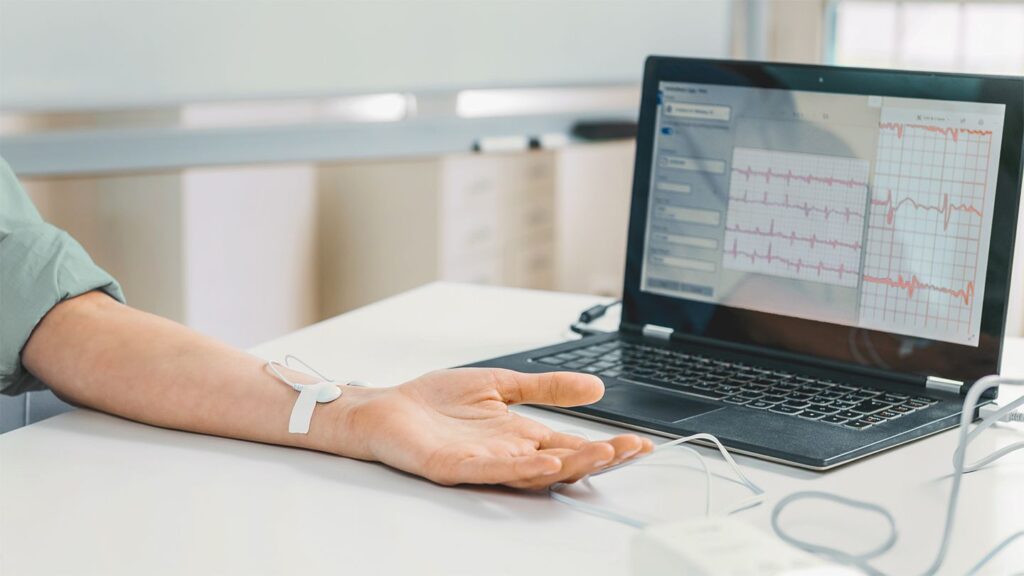
Heart rate variability is the measurement system, not the goal. HRV is the variation in time between consecutive heartbeats, and it gives a usable window onto how the autonomic nervous system is behaving. In NSRT it is used the way a coach uses a power meter: to see whether the training is producing the adaptation, and to adjust when it is not.
This is worth being plain about, because most of the HRV conversation online has gone the other way. A single morning number is not a verdict on you. HRV moves with sleep, alcohol, illness, altitude, training load and the position you were lying in when you measured. What matters is the trend, read in context, by someone who knows what they are looking at. That is the difference between HRV read by a clinician and a score in an app.
Who this is for
NSRT was built with the people Dr. Wiles actually works with in mind: executives carrying sustained decision load, elite and professional athletes, and operators in roles where the cost of a slow recovery is high. The common thread is not that these people are struggling. It is that they are running a nervous system hard and have never trained it directly.
It tends to fit when the pattern looks like this: performance is fine but recovery is not, sleep has become unreliable, the drop from effort into rest takes hours instead of minutes, or pressure that used to be manageable has started to land differently.
What NSRT is not
- It is not a technique. A breathing exercise is a technique. A training discipline has progression logic.
- It is not a tradition. It does not come out of a contemplative lineage and it does not ask you to adopt one.
- It is not a hack. Adaptations take weeks and months, in the nervous system as everywhere else in physiology.
- It is not therapy. NSRT is performance training. It is not treatment for a mental health condition and it is not a substitute for care.
- It is not a score to chase. Raising a number in an app is not the adaptation. The adaptation is how fast you can change state.
Common questions
How is NSRT different from breathwork?
Breathwork is usually a practice you do. NSRT is a training program with a defined target adaptation, an individualized primary stimulus, a measurement system and a progression. Resonance frequency breathing sits inside NSRT as the bottom-up primary, but it is prescribed at your own resonance rate and adjusted against your data rather than done at a general pace.
How long before anything changes?
State changes are immediate. You can feel a resonance frequency session while it is happening. The trait adaptation, the durable change in how quickly your nervous system shifts, comes from consistent practice over weeks. The protocol is built around 4 to 5 sessions a week for that reason. Consistency first, duration second, precision of resonance detection third.
Do I need a wearable or an HRV device?
Measurement helps and it is how progress gets tracked, but the training is the training. Clients work through the The Resilient Engine app, where sessions and HRV data are collected and the resulting reports are reviewed by Dr. Wiles before they are delivered.
Is this the same as HRV biofeedback?
HRV biofeedback is one of the primary tools, not the whole framework. NSRT puts biofeedback inside a structure that also includes sleep as the substrate and attentional training on the top-down axis.
Can NSRT be done remotely?
Yes. The assessment, the protocol design and the ongoing coaching all work remotely, and the app carries the data between sessions. Dr. Wiles works with clients across the United States from Simpsonville, South Carolina.
Who developed NSRT?
Dr. Jay T. Wiles, a clinical health and performance psychologist board certified in heart rate variability and peripheral biofeedback, and co-founder of Hanu Health. He writes about the framework in depth in The Resilient Engine.
Read the framework in full
Dr. Wiles is publishing NSRT piece by piece, in more depth than a service page allows:
- The System You Have Never Trained, the architectural map
- How to Train the Bottom-Up Axis in NSRT, on resonance frequency breathing
- Attention as an Autonomic Input, the introduction to mental attunement training
Working with Dr. Wiles
Coaching is deliberately limited and taken on a small number of clients at a time. If the pattern above sounds like yours, start with the coaching packages or get in touch.
Free guide
How to Read Your Nervous System
Want the argument in full? Eight pages on reading your nervous system, and why years of tracking rarely changes anything.
One confirmation click, then the guide. Unsubscribe whenever you like.