
The Resilient Engine
Tune your Resilient Engine
daily with accountability
Two minutes each morning tells us both how your nervous system is actually recovering. Not how you think it went. What it did.
Invite only Built for clients of the practice

We meet a few times a month
That leaves twenty-something days where you are doing the work on your own, and neither of us can see how it is going. Most coaching runs on memory and self-report, which really means it runs on the days you happened to remember clearly.
A short reading each morning closes that gap. You get a real signal instead of a hunch. I see the same thing you see, so our time together starts from what happened rather than from a recap.
Every morning
Two minutes, before the day starts
Seated and still, before coffee and before your phone. Fingertip over the camera, or a Bluetooth chest strap if you train with one.
You watch your own pulse come up on screen while it records. Taken the same way each morning, it builds the only baseline that matters, which is yours.

The moment it finishes
Your numbers, not a verdict
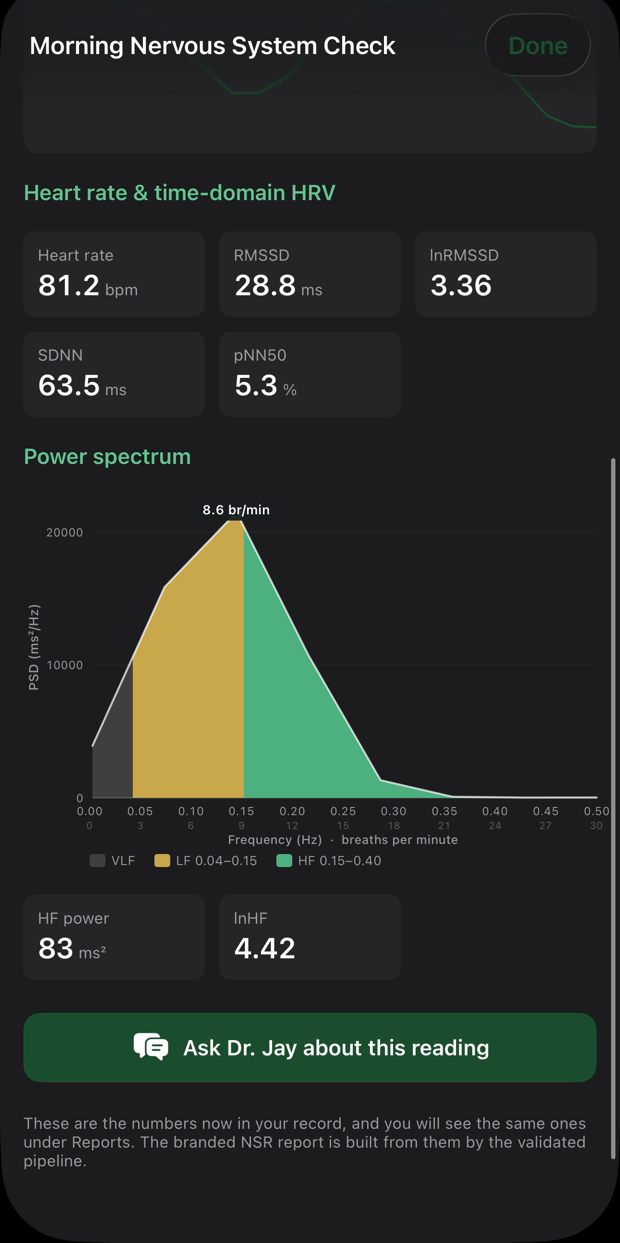
Heart rate, RMSSD, SDNN, the full power spectrum with your breathing rate marked on it. The same measurements behind the Nervous System Resiliency reports I produce in the clinic.
It also asks how resilient you feel, because the gap between what the numbers say and what you feel is often the most useful thing in the room.
The training itself
You can see the moment you find it
Breathe with the pacer and the app scores every breath as it happens. Not afterwards, in a summary. While you are doing it, so you can feel what the change feels like and learn to find it again.

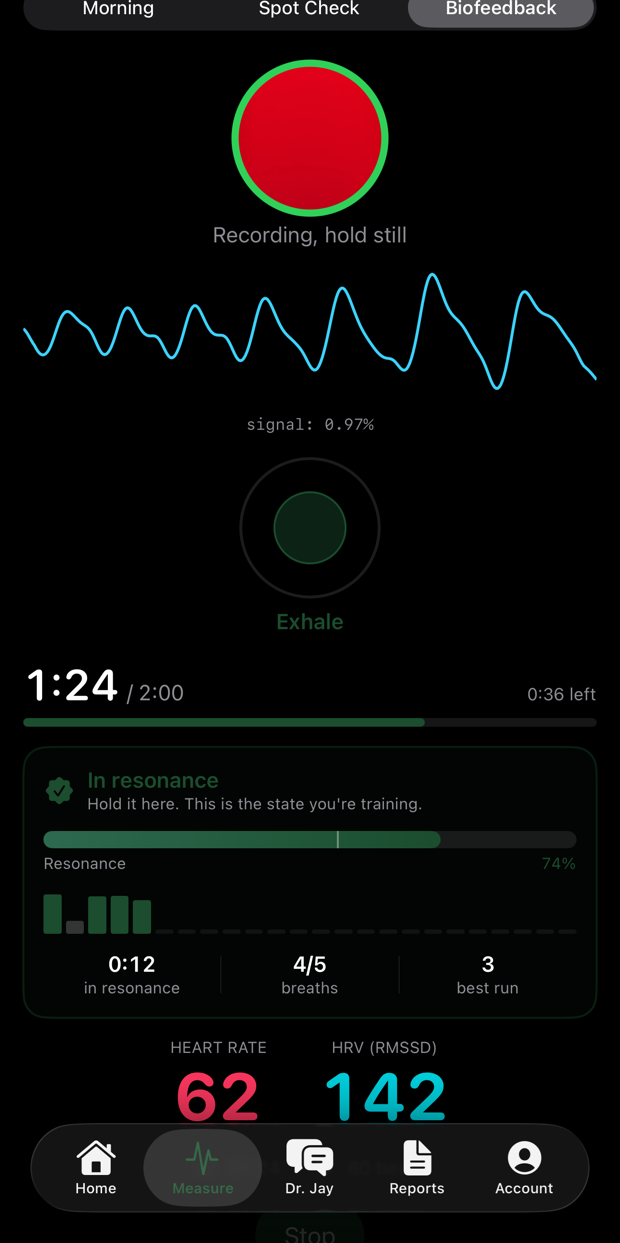
Twenty-two seconds apart, in the same session. The app tells you which state you are in while you are in it, which is the part that makes it trainable rather than just measurable.
The accountability part
Every session, kept
Consistency is the whole game with nervous system training, and consistency is exactly what memory is worst at. So the app keeps the record instead: every session, what your resonance was, how long you held it, and how many days in a row you have shown up.


This is the difference between intending to train and having trained. When we sit down together, neither of us has to guess which one it was.
Whenever you need it
Ask me at eleven at night
Dr. Jay AI is trained on my own published work and can see your readings. Ask why a number moved, whether to train today, or what to do with a week that went sideways.
It is software and it says so, every time. It is coaching and education, not medical advice, and it will tell you when something belongs with your physician instead.

Every week, every month
Reviewed by a person before it reaches you
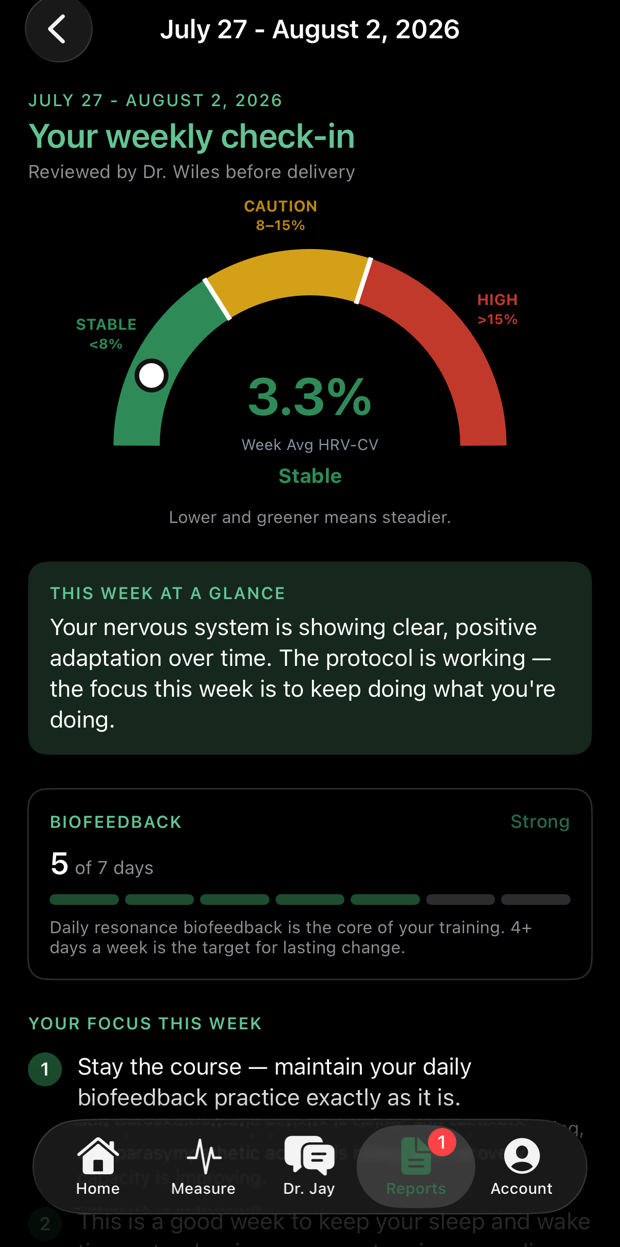
Your weekly check-in and monthly review are built from your own readings, and then I read them before they go out. The app writes the numbers. I decide whether what it is telling you is right.

“28.8 isn’t your nervous system failing.
It’s your nervous system doing its job.”Dr. Jay AI, to a client worried about a low morning reading

What this app will not do
Most of what is sold as recovery tracking is designed to keep you checking it. This was built on a different set of decisions, and they are worth saying out loud.
It will not compare you to strangers
There are no population norms anywhere in this app. Every reference range is your own history. What matters is whether you are steadier than you were, not where you land against a crowd.
“All reference ranges reflect this client’s own historical data only. No population norms are used.” printed at the foot of every report
It will not give you a score to chase
The headline is how consistent your recovery is, and steadier is better. It is a picture of how your system is coping. It is not a grade, and it is not something to try to beat.
It will not save a bad reading
If a recording is too noisy to trust, it asks you to take it again rather than storing a number that looks fine and isn’t. A gap in the record is honest. A wrong number is not.
How you get it
The Resilient Engine is not on the App Store and there is no sign up page. Accounts are created by the practice. Clients get an invite, set it up in a couple of minutes, and start the next morning.
If you are already working with me, you will hear from me directly. If you are not and you would like to, that starts with a conversation rather than a checkout.
Free guide
How to Read Your Nervous System
Not ready to talk yet? Start here. Eight pages on what your HRV data is actually telling you, and what it isn’t.
One confirmation click, then the guide. Unsubscribe whenever you like.
Your readings are health information and they are treated that way. Encrypted in transit and at rest. The app asks for your agreement before it is used, and again before your first conversation with Dr. Jay AI, and keeps a record of exactly what you were shown when you agreed.